
Application Note
When the stack height is already fixed
In a thin device the fastener is usually the last thing chosen and the first thing that has to give. How head form and drive choice recover height without changing the screw diameter.
3
Head forms in production
F / P / C
Countersunk, small pan, pan
M0.6–M2.0
Catalogue range
9
Drive options
The situation
What actually happens in service
A device stack is designed from the outside in. The display, the battery, the board and the housing are placed first, and the fasteners are specified once the mechanical architecture is settled. By that point the vertical space available at each screw position is a fixed number, and it is usually smaller than a standard pan head requires.
The instinct is to reduce the screw diameter to save height. That is usually the wrong lever: a smaller screw reduces clamp load and thread engagement as well, and it may not solve the height problem because the head form, not the diameter, is what consumes the stack.
Analysis
The mechanisms, in order
Each mechanism below produces a different symptom, and each points to a different fix.
01
Head form is the height variable
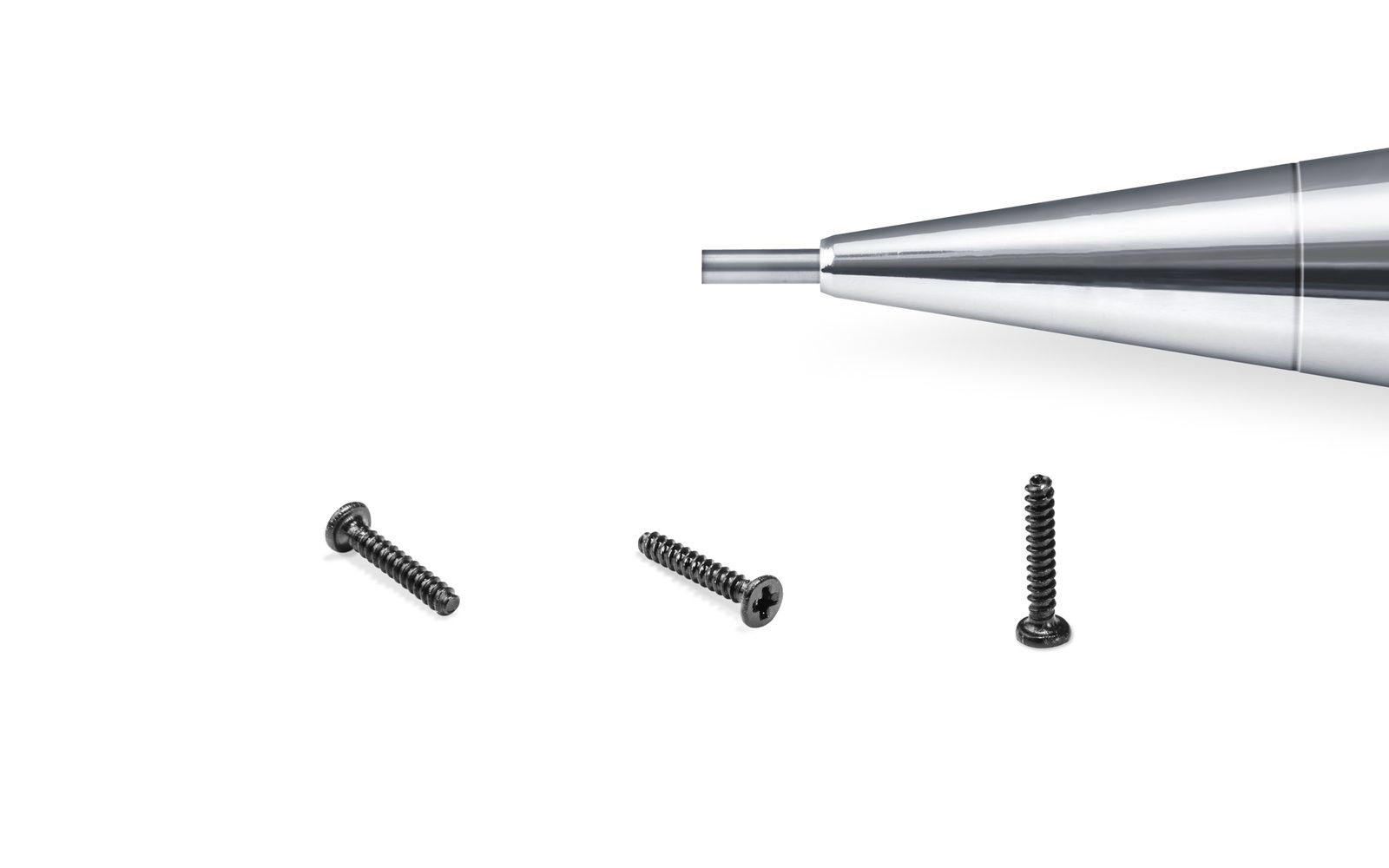
A countersunk head sits inside the material and adds nothing above the surface, which is why it is the default wherever the exterior must be flat. A small pan head reduces the head diameter and height relative to a standard pan head, and is used where the position is tight but the surface is not visible. Choosing between them recovers height without touching the thread.
02
The recess is a height constraint too
A deep recess needs material around it, and in a small head that material is the wall between the recess and the head edge. Below a certain head height the recess becomes fragile, and a drive that needs a deep recess cannot be used regardless of how much height the head saves.
03
Drive choice interacts with the line
A drive that works on a hand driver may cam out on a production driver at rate. Bit engagement, recess depth and the condition of the punch that formed the recess all decide whether the line runs or stops — which is why the drive is validated against the actual production tooling before the die is cut.
04
Undercut heads capture displaced material
In soft or thin material an undercut beneath the head gives the displaced material somewhere to go, so the head seats flush without a witness ring. That is a seating solution rather than a height solution, but the two are usually needed together.
What to specify
Design points worth putting on the drawing
- Decide the head form before reducing the screw diameter
- Check that the recess still has enough wall thickness at the chosen head height
- Validate the drive against the production driver, not a hand driver
- Confirm the thread engagement that remains after the size change
- Consider an undercut head where the material is soft and flush seating matters
- Agree the cosmetic finish at the same time as the head form if the screw is visible
Related products
Parts that address these mechanisms
Keep reading
Other application notes
Embodied Intelligence
Keeping play out of a finger joint
Play in a dexterous finger usually starts at the pivot, not at the screw thread. A short engineering look at why a shoulder screw behaves differently from a plain screw in a rotating joint.
New Energy Vehicles
Why a hot joint loses preload
A joint that holds torque on the bench can relax in service, because steel and aluminium expand at different rates. What the material choice does to preload at temperature.
Send us the joint
A drawing, the service conditions and the failure you are seeing are enough to start. The answer is usually a mechanism, not a part number.