
Application Note
Keeping play out of a finger joint
Play in a dexterous finger usually starts at the pivot, not at the screw thread. A short engineering look at why a shoulder screw behaves differently from a plain screw in a rotating joint.
3-in-1
Connection, location, rotation
Shank
The working surface in a pivot
2 causes
Oval bore, lost preload
M1.0–M2.0
Typical finger-scale screws
The situation
What actually happens in service
A dexterous hand closes on an object thousands of times a day. Each finger is a chain of small linkages, and every linkage turns on a pivot. When the hand is new the motion is clean; after a period in service the fingertip no longer returns to the same place, and fine pinch grasps become unreliable.
The natural assumption is that the screw has loosened. Sometimes it has. But in a rotating joint there is a second mechanism that produces the same symptom and does not involve the thread at all — the pivot bore has worn oval, and the play is in the bore rather than in the fastener.
Analysis
The mechanisms, in order
Each mechanism below produces a different symptom, and each points to a different fix.
01
A plain screw is a poor bearing
When a screw shank turns inside a bore, the thread is carrying the rotation. A thread is a spiral with a small root radius, so the contact area is a fraction of the shank circumference and the contact pressure is high. Over many cycles that pressure wears the bore unevenly, and an oval bore produces play that no amount of re-tightening will remove.
02
A shoulder screw moves the wear surface
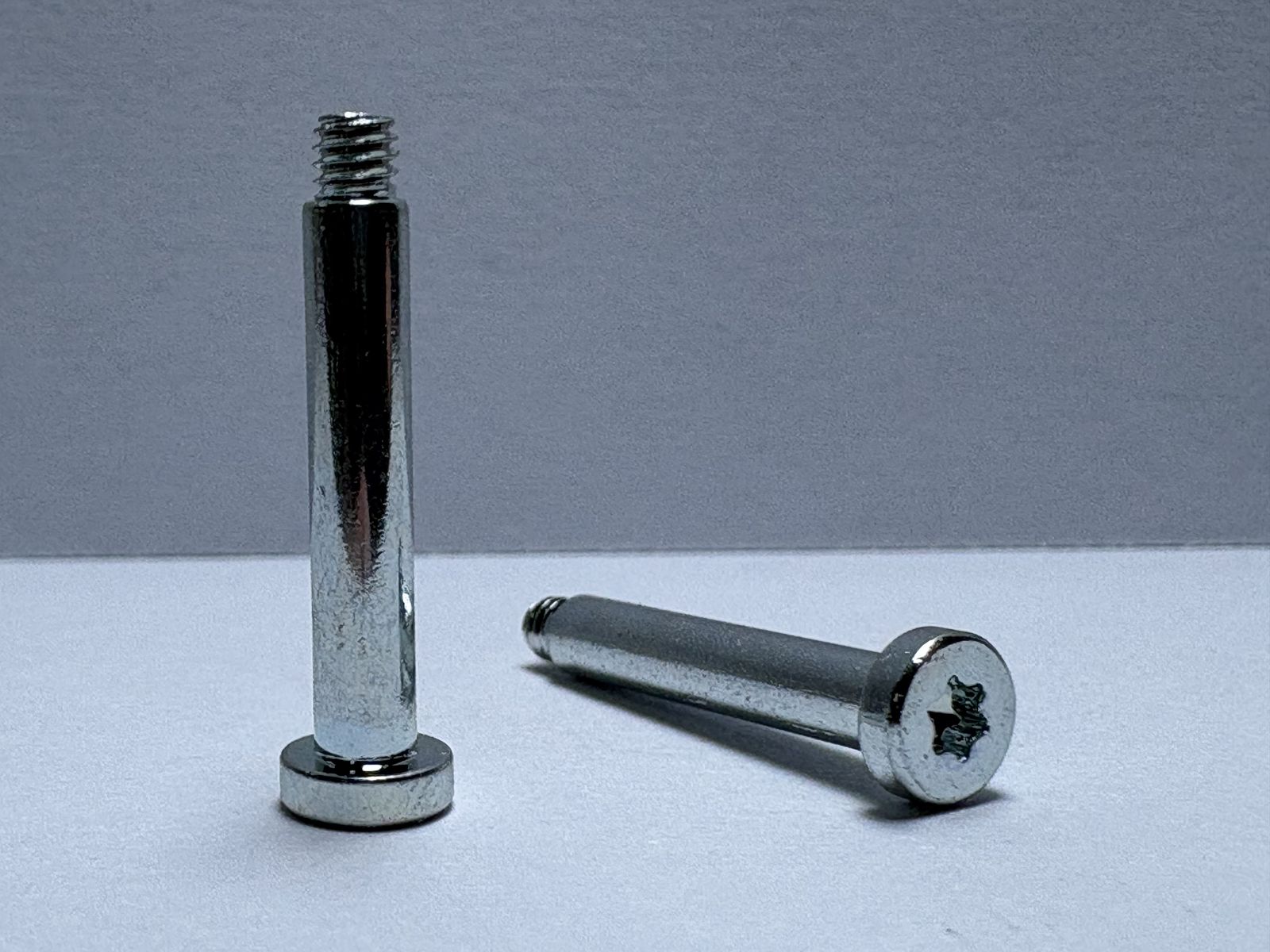
A shoulder screw has an unthreaded, ground shank that acts as the bearing diameter. The load is spread over the full circumference instead of a thread crest, the surface is smoother, and the diameter can be toleranced against the bore rather than against a nut. The thread is then only doing the clamping, which is what a thread is good at.
03
Straightness matters as much as diameter
A pin can measure correctly at every cross-section and still be bent. In a short bore a small bend shows up as edge contact, which wears the bore at two points and produces play even though the diameter is right. This is why a pivot pin is specified for straightness over its length, not just for diameter at one section.
04
The clamp screw is a separate problem
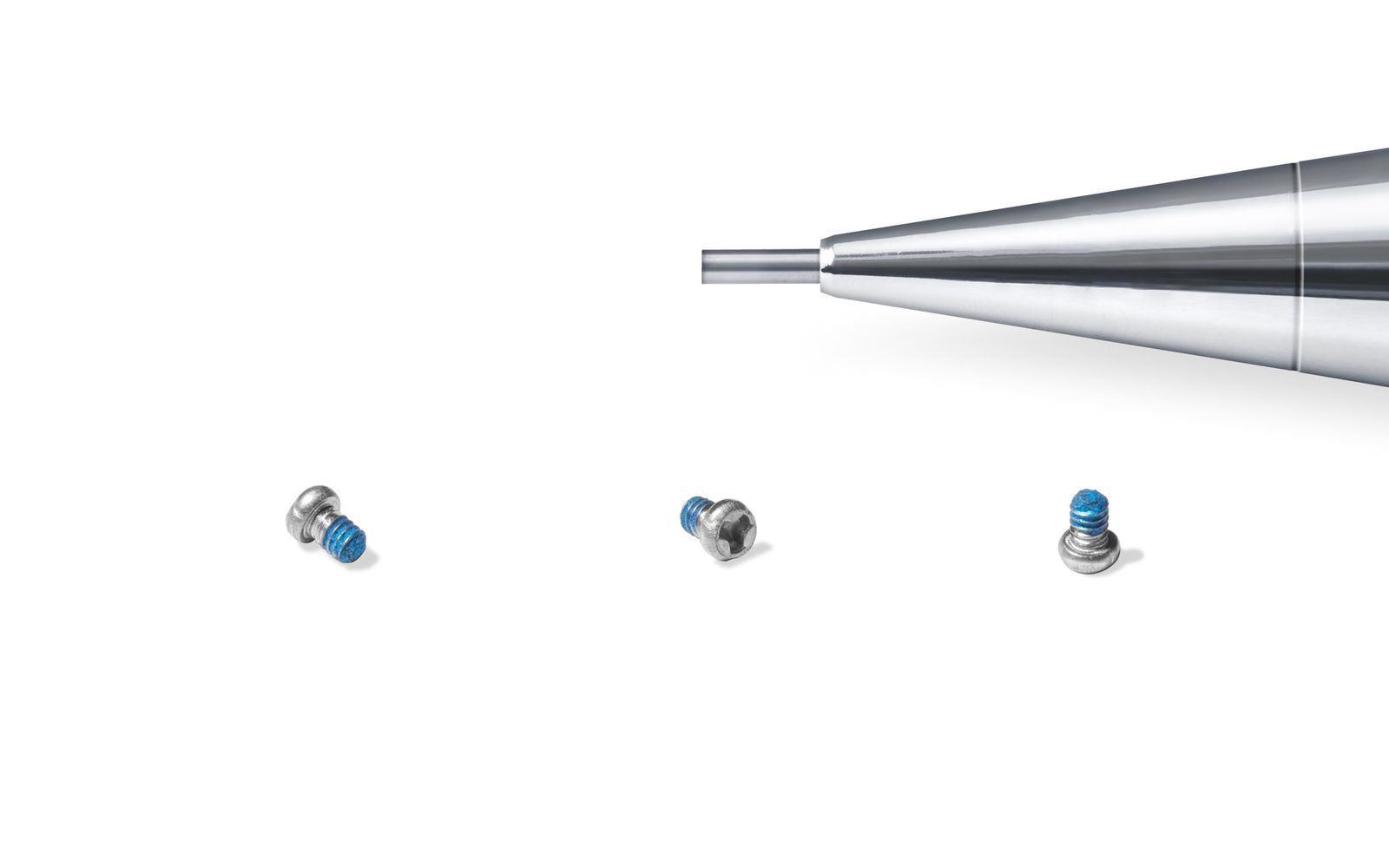
Once the pivot is correct, the remaining source of play is the clamp. Linkage plates held by a screw that loses preload will fret against each other, and the movement looks like joint play. A pre-applied locking element on the clamp screw addresses that mechanism separately from the pivot.
What to specify
Design points worth putting on the drawing
- Tolerance the shoulder against the mating bore, not against a nominal value in isolation
- Specify straightness over the shoulder length in addition to diameter and roundness
- Separate the pivot function from the clamping function so neither compromises the other
- Match the shoulder material and finish to whether the joint rotates continuously or occasionally
- Use a pre-applied locking element on clamp screws where the load reverses
- Plan for the pivot to be a replaceable wear part rather than an integrated feature of the moulding
Related products
Parts that address these mechanisms
Keep reading
Other application notes
Consumer Electronics
When the stack height is already fixed
In a thin device the fastener is usually the last thing chosen and the first thing that has to give. How head form and drive choice recover height without changing the screw diameter.
New Energy Vehicles
Why a hot joint loses preload
A joint that holds torque on the bench can relax in service, because steel and aluminium expand at different rates. What the material choice does to preload at temperature.
Send us the joint
A drawing, the service conditions and the failure you are seeing are enough to start. The answer is usually a mechanism, not a part number.