Micro Screws · From M0.8 × 1.0 mm
Precoated Screws
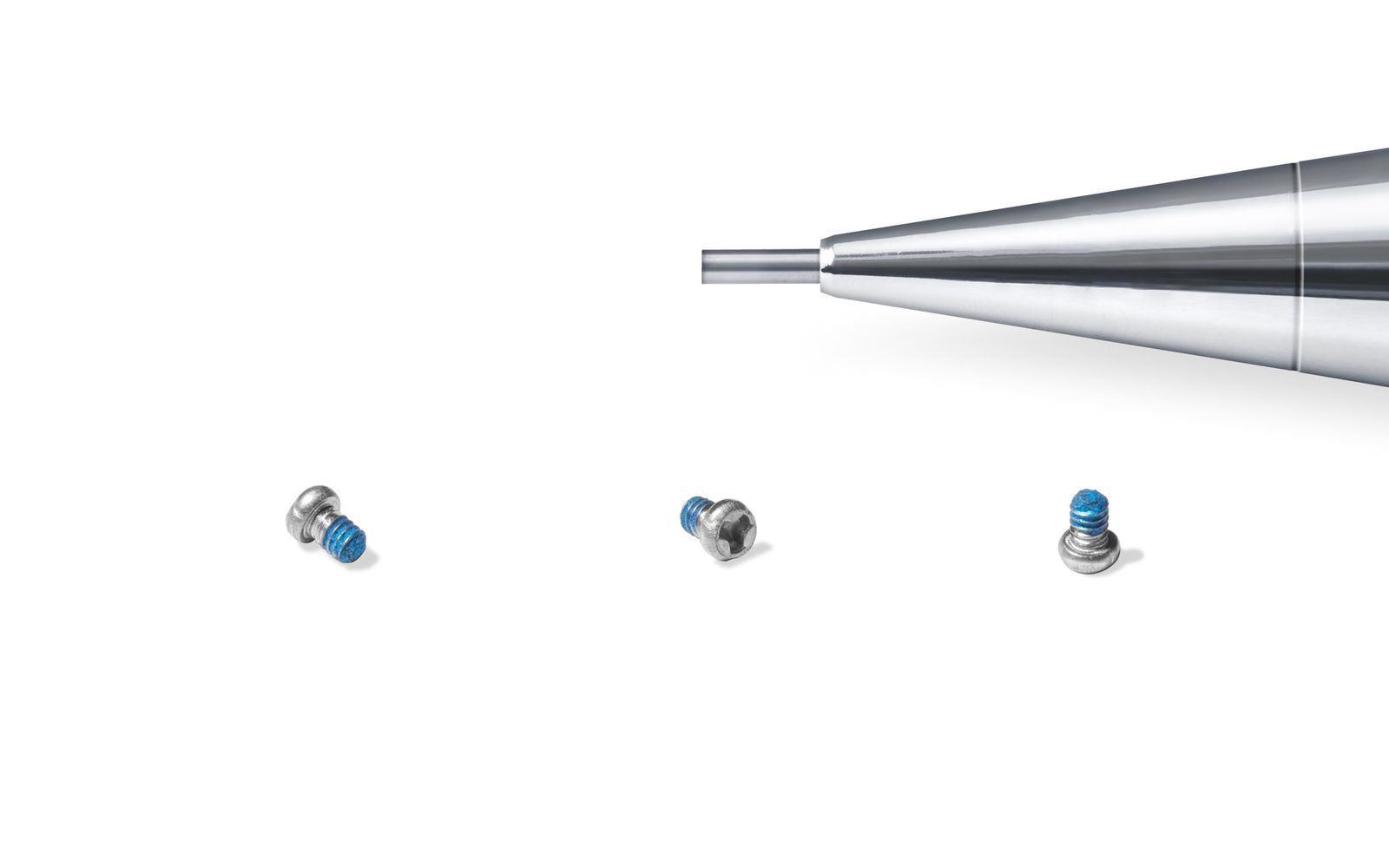
Screws supplied with a locking, sealing or vibration-damping element already applied — micro-encapsulated adhesive, nylon patch, sealant or damping coating, from M0.8 upward.
Thread & Panel
Anti-loosening at the joint and transmission interface
Joint anti-loosening · Thread & Panel Overview
Bolted joints fail in service for one reason more often than any other: they lose preload. Vibration, thermal cycling and repeated load reversal all allow the joint to relax, and once clamp load is gone the fastener is only being held by friction that is no longer sufficient. A lock washer intervenes at exactly that point, adding a resisting element between the fastener and the joint face.
In a humanoid robot the lock washer is one of the core anti-loosening fasteners for joints and transmission systems. Carbon steel and stainless steel cover the standard range; for high-end applications there is a gradual shift toward high-strength alloy steel and lightweight composite materials, to meet the requirements of high-frequency vibration, high precision and long service life.
Function
Anti-loosening at joints and transmission systems
Standard materials
Carbon steel, stainless steel
High-end materials
High-strength alloy steel, lightweight composite
Application
Robot joints, transmission systems, vibration-exposed joints
Requirement drivers
High-frequency vibration, high precision, long service life
Forms
Spring washer, toothed lock washer, wave washer, conical washer
Design intent
Six engineering decisions that separate a micro fastener that works from one that merely fits the drawing.
A dedicated locking function at the joint face, independent of the screw thread and of any adhesive.
Used in robot joints and transmission systems where load reverses continuously and preload loss is the dominant failure mode.
Carbon steel for general joints, stainless steel where corrosion resistance is required.
For high-end applications the material shifts to high-strength alloy steel to carry higher preload without yielding.
Composite materials are increasingly evaluated for weight-critical joints where a steel washer is disproportionate to the assembly.
Specified where the joint sees continuous vibration, needs high precision and must survive a long service life.
Technical data
Reference data for design and sourcing. For a specific part, the drawing governs — these tables are the starting point for a joint review.
| Form | Mechanism | Best for | Re-use |
|---|---|---|---|
| Spring washer | Axial spring force maintains preload | General vibration-exposed joints | Limited |
| Toothed lock washer | Teeth bite into the joint face | Electrical and earth connections, high grip | No — single use |
| Wave washer | Controlled axial load over a small deflection | Bearing preload, compact joints | Yes |
| Conical washer | Disc spring behaviour with high load | High-preload joints in a short stack | Yes |
Values are typical for the stated material and finish. Actual performance depends on the mating material, engagement length and assembly torque. Confirm with a sample test before design freeze.
Options
Mix these within one part number family. Where a combination is not manufacturable at your tolerance, we will say so at quotation rather than after the first lot.
Where it is used
Representative positions rather than an exhaustive list. Many of our parts are designed for one specific assembly and never appear in a catalogue.
| Assembly | Typical use |
|---|---|
| Robot joint | Maintaining preload in a joint that reverses load continuously |
| Transmission system | Anti-loosening at gearbox and drive interfaces |
| Bearing preload | Wave washer applying a controlled axial load |
| Earth connection | Toothed washer biting through coating for electrical contact |
| Vibration-exposed bracket | Spring washer under the fastener head |
| Compact joint | Conical washer delivering high load in a short stack |
Quality control
Inspection is not a final gate. It is a set of checks placed where a process can actually drift, with the result recorded against the lot code.
01
Inner and outer diameter, thickness
02
Spring load or compression force on sample basis
03
Hardness and material certificate
04
Tooth geometry on toothed variants
05
Plating thickness and appearance
06
Freedom from cracks at the split
07
Flatness and burr condition
Questions
The questions our engineers answer most often on this product family.
Related products
These families are frequently used in the same assembly, or as an alternative when the joint requirement changes.
Micro Screws · From M0.8 × 1.0 mm
Screws supplied with a locking, sealing or vibration-damping element already applied — micro-encapsulated adhesive, nylon patch, sealant or damping coating, from M0.8 upward.
Micro Screws · M0.6 – M2
Micro machine screws that engage a pre-formed thread — a tapped hole, a brass insert or a heat-set nut — and hold their clamp load through repeated disassembly.
Thread & Panel · Access panels & covers
Captive screws remain attached to the panel after loosening, so a cover can be removed without the fastener falling into the equipment or getting lost.
Send a drawing or 3D model with the mating material and finish requirement. The reply is a process route, a tolerance review and a price — with the assumptions stated.