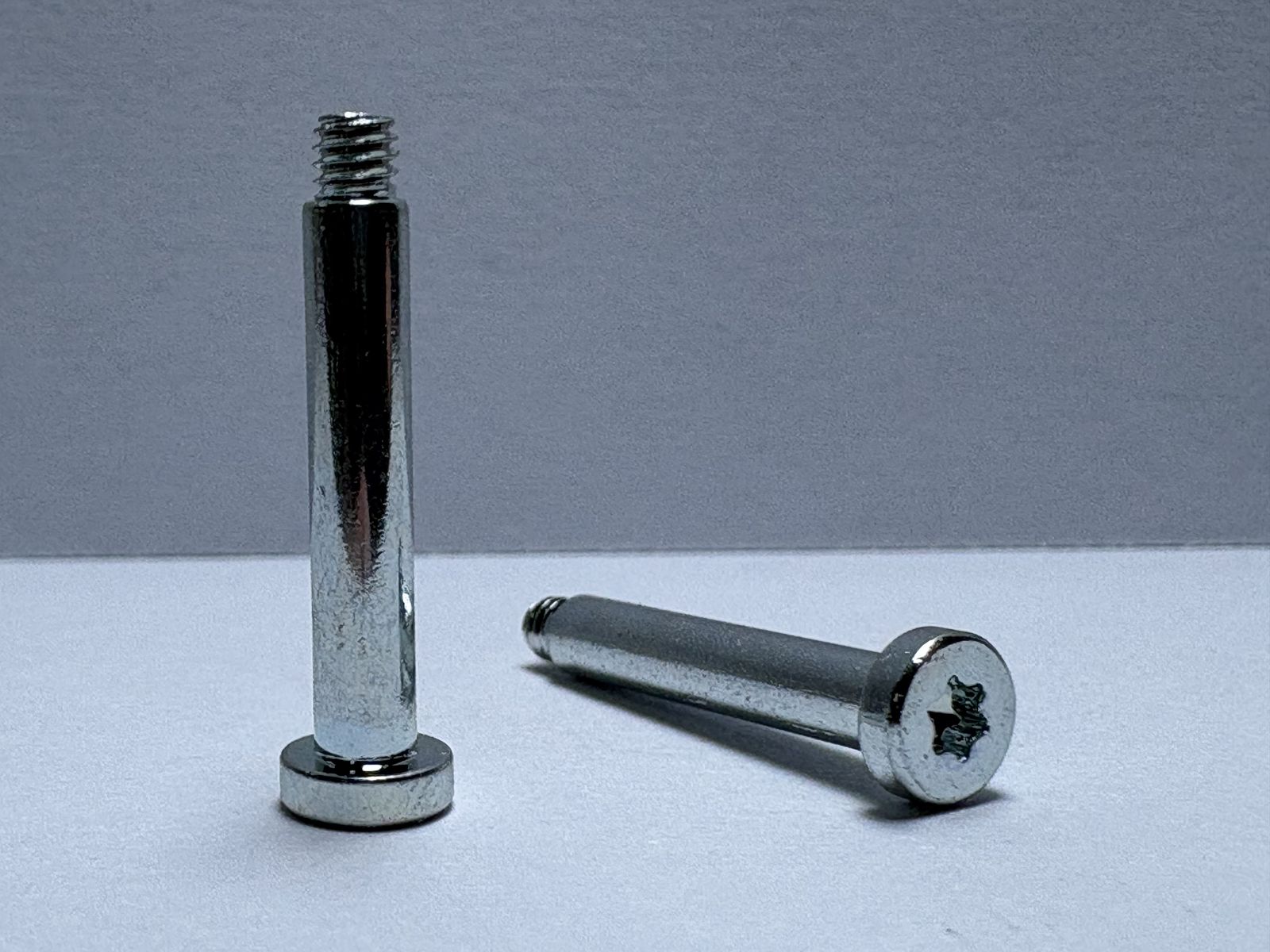
Precision Components · Ø1.0 – Ø10 mm
Shoulder Screws & Pins
Precision shoulder screws, dowel pins and stepped pins ground to h9 for pivot, locating and alignment duties in miniature mechanisms.
h9 ground shankPivot & locatingStainless / alloy
Case study
A 16-DOF dexterous hand was losing repeatability after 200,000 cycles. Ground shoulder pins and encapsulated screws took backlash out of the finger chain.
−72%
Joint backlash after 10⁶ cycles
10⁶
Cycles without re-torque
h7
Shoulder pin fit class
0.01
Straightness (mm per 10 mm)
Client: Humanoid robotics programme, Southeast Asia · Industry: Robotics & Dexterous Hands
The challenge
The hand used M1.6 shoulder screws as phalanx pivots and M1.4 screws to clamp the linkage plates. After 200,000 cycles the team measured up to 0.35 mm of tip play, which showed up as a 4 mm positioning error at the fingertip and made fine pinch grasps unreliable.
Two mechanisms were at work. The original shoulder screws were turned, not ground, and their shanks were slightly bent — enough to bind in the phalanx bore and wear it oval. Separately, the clamp screws were losing preload under reversing load, so the linkage plates were fretting against each other.
At a glance
Products specified
Shoulder Screws · Precoated · Machine Thread
The approach
Each change addresses a specific failure mechanism rather than tightening a specification in general.
01
We replaced the turned shoulder screws with h7 ground pins in SUS420 hardened to HRC 50, straightness held at 0.01 mm per 10 mm, Ra 0.2. The diameter was not the main fix — the straightness was.
02
The original design had a sharp corner under the head, which acted as a stress riser and allowed the pin to flex. A controlled radius spread the load and reduced the bending that was binding the bore.
03
Encapsulated adhesive was applied at a defined thread position on the M1.4 clamp screws. This removed the need for a separate washer and kept preload through reversing load.
04
A PEEK bushing was specified with a clearance derived from the pin tolerance and the expected temperature rise, rather than a catalogue clearance.
05
The joint was cycled to 10⁶ reversals with backlash measured every 100,000 cycles. The first design lost 0.12 mm in the first 200,000; the revised design lost 0.03 mm over the full million.
The result
01
Tip positioning error fell from 4 mm to 1.1 mm at the same grasp force.
02
No re-torque was required across 10⁶ cycles in the test rig.
03
The pin and bushing combination eliminated the oval wear pattern in the phalanx bore.
04
The same pin family was adopted for the wrist joint, simplifying the Bill of Materials from 9 fastener part numbers to 4.
Products used
These families carried the joint. A different combination may suit your assembly — the engineering method is the same.
Precision Components · Ø1.0 – Ø10 mm
Precision shoulder screws, dowel pins and stepped pins ground to h9 for pivot, locating and alignment duties in miniature mechanisms.
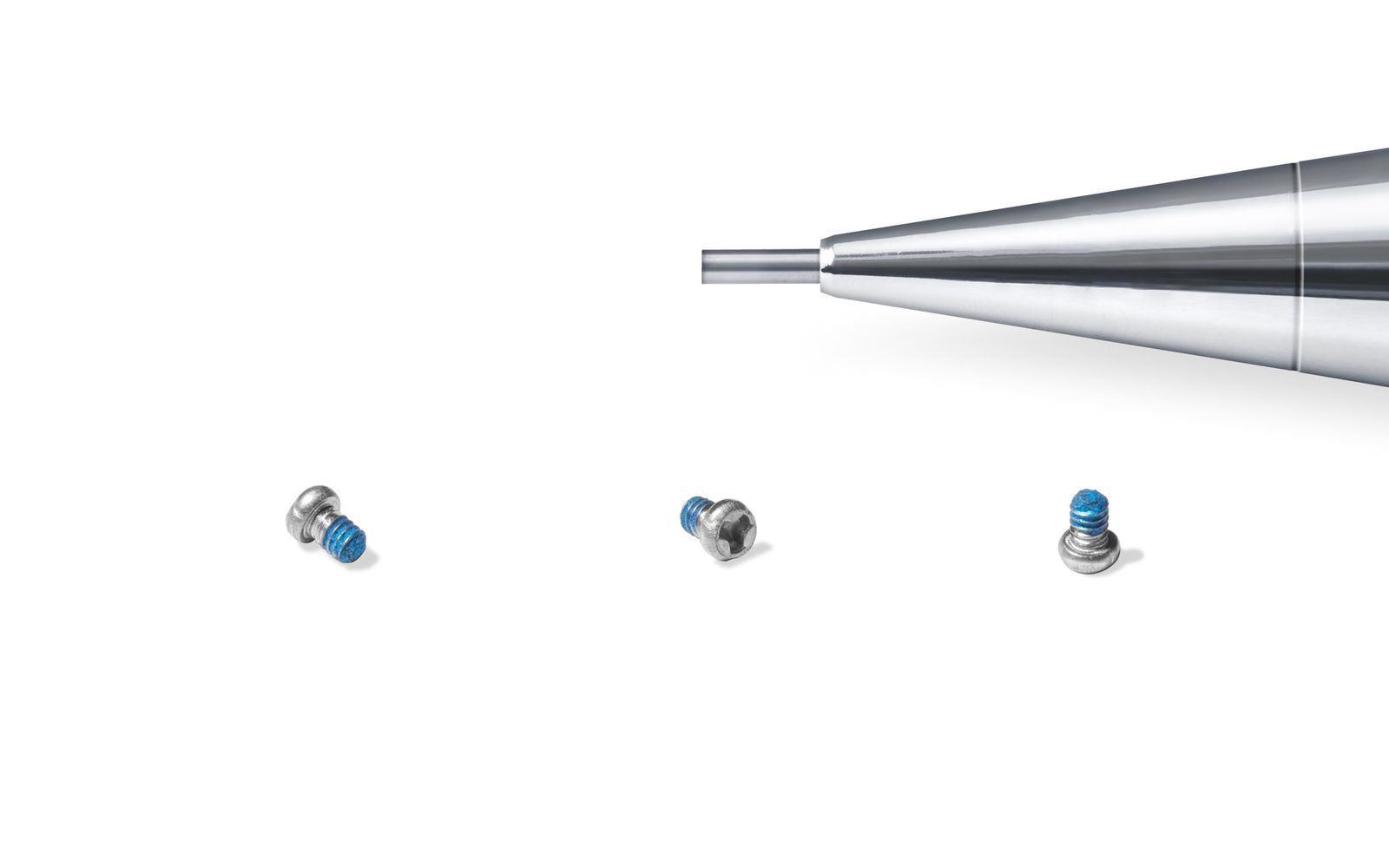
Micro Screws · M0.8 – M6
Screws with a factory-applied locking or sealing element, so the assembly line receives a ready-to-drive fastener with no liquid adhesive and no cure time.
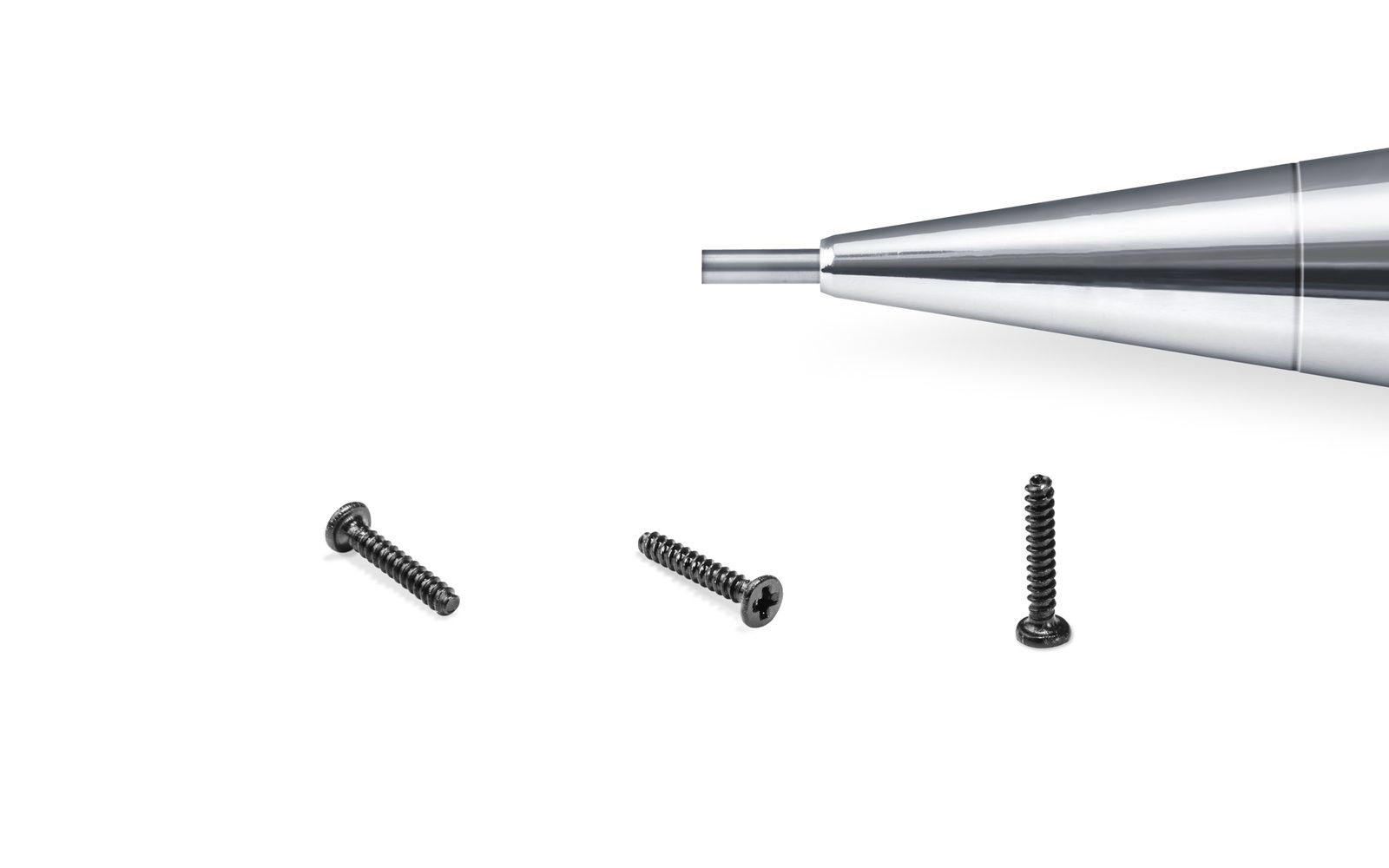
Micro Screws · M0.5 – M6
Precision machine screws from M0.5 to M6 with rolled Class 6g threads, tight head concentricity and clean drive recesses for automated driving.
Send the joint drawing, the cycle count and the failure mode. We will tell you whether the fix is a fastener, a tolerance or a design change.