Product Description
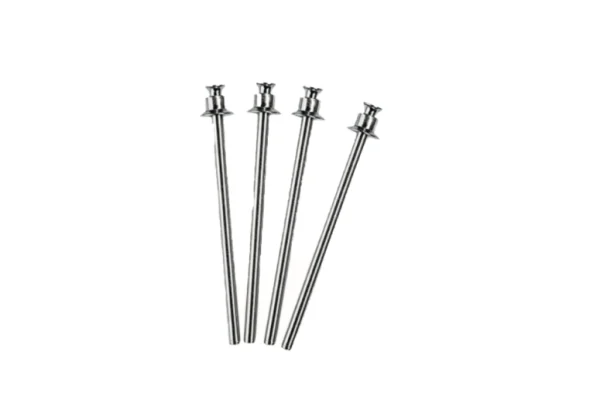
PT Rivets — also known as countersunk pull-through blind rivets or flush-flush blind rivets — are engineered for assemblies where nothing may be left loose inside. In a conventional blind rivet the mandrel breaks off and its head remains captured inside the panel cavity. In the PT design the mandrel is drawn completely through and extracted from the backside during setting, so no fragment stays behind.
Three design features define the product. First, the pull-through mandrel eliminates internal debris entirely — no residual steel balls or metal fragments are left inside electronic devices or precision appliances, removing the risks of short circuits, abnormal noises and PCB scratches. Second, the dual-side countersunk structure keeps both faces of the panel flat after riveting, with backside protrusion held to ≤0.4mm, so the joint does not interfere with adjacent components or scratch moving parts. Third, the mandrel head remains integrally attached to the shaft throughout setting, which rules out stray metal fragments falling into the assembly.
Material options cover the usual range of duty. The standard version is carbon steel (C1006/1010) fully zinc-plated for corrosion resistance, offering high strength at low cost. Stainless steel (Grade 304/316) is available for outdoor, high-humidity and highly corrosive environments, and aluminum for lightweight applications and thin sheet metal. Nominal diameters are 3.2mm, 4.0mm and 4.8mm, with grip lengths covering panel thicknesses from 0.5mm to 6.0mm, and a standard 90° countersunk head that matches pre-countersunk holes.
Compared with standard break-stem countersunk rivets, the practical differences are clear: no mandrel retention inside the panel, a flush backside instead of a protrusion, suitability for precision electronics where loose mandrel heads are a banned risk, and no secondary grinding to flatten a bulging back. Setting requires a dedicated pull-through blind riveting tool — standard break-stem rivet guns cannot be used — and the mating substrates must be pre-drilled with a 90° countersunk hole to achieve the dual-side flush effect. Mandrels are colour-coded by length so line operators can identify models quickly and avoid installation errors.
Application Industries
In electronics and electrical appliances — the core scenario — PT rivets are used in laptops, industrial PC chassis, refrigerator and air-conditioner liners, electrical control boxes and PCB mounting, where loose internal hardware is unacceptable.
Automotive interiors use them in sunroof assemblies, audio enclosures, door panel trims and console glove box glides. Sheet metal furniture such as metallic cabinet drawers, server racks and precision toolboxes benefit from the flush, grind-free finish, and precision equipment including instrument enclosures, medical device housings and ultra-thin decorative panels relies on their debris-free, dual-side flush performance.