
More +
Hex Flange Serration Screw with Dual-Lock Vibration Proofing
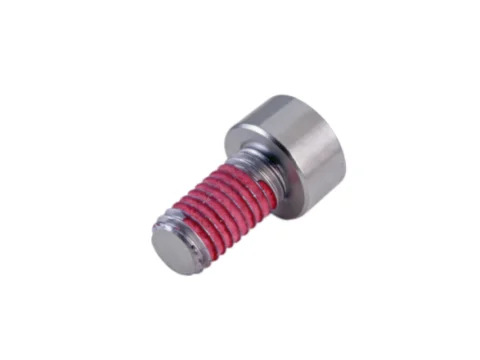
This screw exists for one purpose: staying tight where loosening would be catastrophic. It combines two independent locking mechanisms. The first is mechanical — 360° radial serrations under the flange bite into the mating surface, resisting rotational slip and surviving more than 12,000 cycles at 30Hz (per ISO 16130 Class B). The second is chemical — a pre-applied anaerobic adhesive, equivalent in behaviour to a high-strength threadlocker such as Loctite 271, which keeps 95% torque retention after 1,000 hours of salt spray (ASTM B117) for under-hood and outdoor duty.
The flange does more than carry the serrations. Its bearing surface is 40% larger than a standard hex screw, which spreads clamp load and inhibits the surface creep that eventually relaxes a joint. At M10 in Grade 10.9 (ISO 898-1) the design delivers 18 kN of clamping force, enough to keep gasket compression stable in power equipment and machinery.
Installation stays conventional: the external hex conforms to ISO 4014 and can be driven with standard twelve-point sockets with zero cam-out, even in confined spaces with less than 5mm of clearance. That means the reliability gain does not require new tooling or unfamiliar assembly procedures.
Suited where loosening costs production time, the screw serves automotive manufacturing in engine blocks, transmission housings and EV battery trays exposed to thermal cycling, heavy machinery such as excavator booms and hydraulic manifolds that must resist shock loads, and rail transit applications including bogie frames and pantograph mounts where fire safety and long no-loosening service intervals are specified.
Power equipment is another core application: substation busbars and wind turbine nacelles, where a sealed, dust- and moisture-resistant joint prevents corrosion and electrical failure over decades of outdoor exposure.