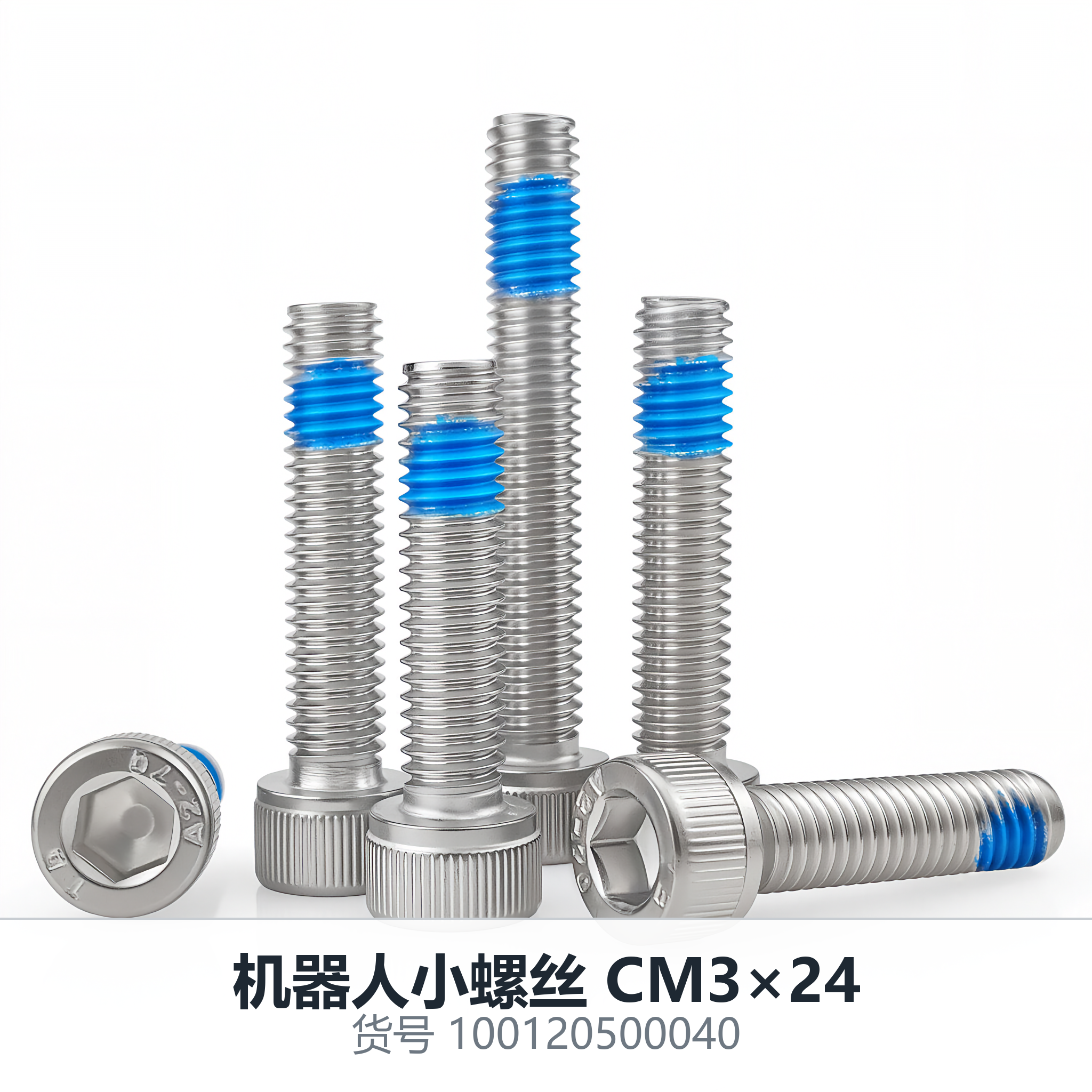
Robot Micro Screw CM3×24
Robot micro screw (CM3×24), 3×24 mm micro hex-socket cylindrical head with blue locking adhesive pre-applied to the thread, developed for micro assembly in humanoid robots, dexterous hands and embodied-AI hardware. Precision turning plus thread rolling gives stable torque without cam-out; customisation to drawing is supported.
| Inventory Code | 100120500040 |
|---|---|
| Inventory Name | Screw |
| Inventory Spec | CM3×24 |
| Qty | 66700 |
| Unit | pcs |
| Warehouse | Small screw warehouse |
| Warehouse Code | 2 |
| Location Code | 2601 |
Overview
Robot micro screws are the sub-M2 fasteners used inside articulated robot joints, end effectors and humanoid actuator housings. The requirement differs from consumer electronics: the joint is in continuous motion, so the screw sees cyclic load rather than a single assembly preload, and a backed-out screw inside a joint can destroy the mechanism rather than simply loosen a cover. This listing: size CM3×24.
What sets this listing apart: Qty 66700; Location Code 2601.
Advantages
Preload is specified as a band rather than a maximum, because both under-tightening (loosening under vibration) and over-tightening (yield in a 1.4 mm section) cause the same field failure.
Coating choice is driven by wear at the driver interface, since actuator housings are assembled in volume and the recess is engaged by robotic drivers that will cam out of a worn recess.
Tight dimensional control on head diameter allows the screw to sit inside a bearing race envelope without fouling adjacent rotating parts.
Thread form and material are selected for fatigue rather than for one-time clamp: a rolling thread root on a case-hardened screw resists the notch sensitivity that causes micro screws to snap after thousands of load cycles.
Applications
Harmonic and cycloidal actuator housings, robot wrist and elbow joints, end-effector gripper bodies, linear actuator end caps, and humanoid robot hand assemblies where fastener mass affects dynamic response.
For joints in continuous motion specify prevailing torque or a pre-applied patch rather than relying on torque alone; a plain screw in an aluminium actuator housing will lose preload within a few thousand cycles. Check that the screw material is compatible with the lubricant used in the joint.
Product information is supplied by Toprecision. Custom parts can be produced to drawing — contact us for samples or a quotation.
Specifications across this series
113 parts in this series
| Part | Material | Finish | Grade | Inventory Code |
|---|---|---|---|---|
| Robot Micro Screw CM2×4 · 100120500035 | — | — | — | 100120500035 |
| Robot Micro Screw FM2×6 · 100120500036 | — | — | — | 100120500036 |
| Robot Micro Screw CM2.5×6 · 100120500037 | — | — | — | 100120500037 |
| Robot Micro Screw CM3×6 · 100120500038 | — | — | — | 100120500038 |
| Robot Micro Screw CM5×8 · SCM435 / Zinc-nickel alloy / Class 12.9 | SCM435 | Zinc-nickel alloy | Class 12.9 | 100120500039 |
| Robot Micro Screw CM3×24 · 100120500040 | — | — | — | 100120500040 |
| Robot Micro Screw CM5×10 · SCM435 / Zinc-nickel alloy / Class 12.9 | SCM435 | Zinc-nickel alloy | Class 12.9 | 100120500041 |
| Robot Micro Screw CM1.4×3.00 · SCM435 / Zinc-nickel alloy / Class 10.9 | SCM435 | Zinc-nickel alloy | Class 10.9 | 100120500042 |
| Robot Micro Screw M2.5×4.00 · 100120500043 | — | — | — | 100120500043 |
| Robot Micro Screw CM2X3 · SCM435 / Zinc-nickel alloy / Class 10.9 | SCM435 | Zinc-nickel alloy | Class 10.9 | 100120500044 |
Values are taken from each part’s own attribute set. Changing length, material or finish changes pull-out strength and installation torque, so compare the row that matches your drawing.
Selection and test data: engagement length, standards, salt-spray hours
FAQ
What are the key dimensions of this part?
Inventory Code 100120500040, Inventory Name Screw, Inventory Spec CM3×24, Qty 66700.
What material and finish is it supplied in?
Carbon Steel.
What should I verify before ordering or installing it?
For joints in continuous motion specify prevailing torque or a pre-applied patch rather than relying on torque alone; a plain screw in an aluminium actuator housing will lose preload within a few thousand cycles. Check that the screw material is compatible with the lubricant used in the joint.